Фракталы городской культуры
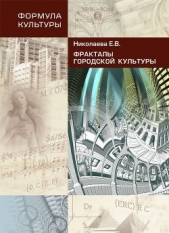
Фракталы городской культуры читать книгу онлайн
Монография посвящена осмыслению пространственных и семантических «лабиринтов» городской культуры (пост)постмодерна с позиций цифровых гуманитарных наук (digital humanities), в частности концепции фрактальности.
Понятия «фрактал», «фрактальный паттерн», «мультифрактал», «аттракторы» и «странные петли обратной связи» в их культурологических аспектах дают возможность увидеть в городской повседневности, в социокультурных практиках праздничного и ночного мегаполиса фрактальные фор(мул)ы истории и культуры. Улицы и городские кварталы, памятники и скульптуры, манекены и уличные артисты, рекламные билборды и музейные артефакты, библиотеки и торговые центры, огненные феерии и художественные проекты – как и город в целом – создают бесконечные фрактальные «узоры» локальной и мировой культуры.
Книга рассчитана на широкий круг читателей, включая специалистов по культурологии, философии, социальной и культурной антропологии, преподавателей и студентов гуманитарных вузов, всех, кого интересует городская культура и новые ракурсы ее исследования.
Внимание! Книга может содержать контент только для совершеннолетних. Для несовершеннолетних чтение данного контента СТРОГО ЗАПРЕЩЕНО! Если в книге присутствует наличие пропаганды ЛГБТ и другого, запрещенного контента - просьба написать на почту [email protected] для удаления материала
110. Benguigui В., Chamanski D., Marinov M, Portugali Y. When and where is a city fractal? Environment and planning B: Planning and design, Vol. 27, 2000, pp. 507–519.
111. Bovill C. Fractal geometry in architecture and design. Boston; Basel; Berlin: Birkhäuser, 1996.
112. Bourke P. Representing and modelling geometry in SecondLife. 2007. URL: http://paulbourke.net/fractals/secondlife/index.html.
113. Brown C. T., Liebovitch L. S. Fractal Analysis (Quantitative Applications in the Social Sciences). SAGE Publications, 2010.
114. Brown C, Witschey W. The fractal geometry of ancient Maya settlement. Journal of Archaeological Science, № 30, 2003. P. 1619–1632.
115. Caglioni M, Giovanni R. Contribution to fractal analysis of cities: A Study of metropolitan Area of Milan. 6 èmes Rencontres de Thé o Quant, BesanQon, France 20–21 février 2003. URL: http://cybergeo.revues.org/index3634html.
116. Chen Y., Lin J. Modeling the self-affine structure and optimization conditions of city systems using the idea from fractals. Solitons and Fractals, Vol. 41, No. 2, 2009, P. 615–629.
117. Crompton A., Brown F. The Double Fractal Structure of Venice. Proceedings, 6th International Space Syntax Symposium, İstanbul, 2007. URL: http://www.spacesyntaxistanbul.itu.edu.tr/papers/longpapers/011%20-%20Crompton%20Brown.pdf
118. Downton P. F. Ecopolis: Architecture and Cities for a Changing Climate. Dordrecht: Springer Science+Business Media B. V. & Collingwood: CSIRO PUBLISHING, 2009.
119. Eaton L. Fractal Geometry in the Late Works of Frank Lloyd Wright. Nexus II: Architecture and Mathematics. K. Williams, ed. Fucecchio (Florence): Edizioni Dell’Erba. 1998, pp. 23–38.
120. Ebert D. S., Musgrave F. K., Peachey D., Perlin K., Worley S. Texturing & Modeling. A Procedural Approach. 2nd edition. AP Professional, 1998.
121. Eglash R. African Fractals: modern computing and indigenous design. Rutgers University Press, 1999.
122. Eichberg, Henning.The labyrinth of the city – Fractal movement and identity. Nature and Identity. Esseys on the Culture of Nature. K. Pedersen & A. Viken (eds.) Kristiansand: HøyskoleForlaget, 2003, pp. 265–301
123. Frankhauser P. The fractal approach. A new tool for the spatial analysis of urban agglomerations. Population, 10 e année, № 1, 1998, pp. 205–240.
124. Gannon M. Understanding Global Cultures: Metaphorical Journeys Through 23 Nations. 2 nd Ed. Thousand Oaks, CA: Sage, 2001.
125. Gannon M. J. The Cultural Metaphoric Method: Description, Analysis, and Critique. International Journal of Cross-Cultural Management, 2009, vol. 9 (3), pp. 275–287.
126. Goldberger A. L. Fractals and the birth of Gothic: reflections on the biological basis of creativity. Molecular Psychiatry, 1, 1996, pp. 99–104.
127. Grout V., Rezaul K. M. The Fractal Internet: Traffic analysis, simulation, estimation and control. North East Wales Institute of Higher Education, 2009.
128. Haggard K. Fractal Architecture: Design for Sustainability. BookSurge Publishing, 2006.
129. Harris J. Fractal Architecture: Organic Design Philosophy in Theory and Practice. University of New Mexico Press, 2012.
130. Hodge B. and Lally E. Cultural planning and Chaos Theory in Cyberspace: some notes on a Digital Cultural Atlas Project for Western Sydney. The Fibreculture Journal, № 9, 2006. URL: http://nine.fibreculturejournal.org/fcj-056-cultural-planning-and-chaos-theory-in-cyberspace-some-notes-on-a-digital-cultural-atlas-project-for-western-sydney/.
131. Jackson W. J. Heaven’s fractal net: retrieving lost visions in the humanities. Indiana University Press, 2004.
132. Jencks Ch. The New Paradigm in Architecture. New Haven: Yale University press, 2002.
133. Joye Y. Fractal Architecture Could Be Good for You. Nexus Network Journal, Vol. 9, № 2, 2007, pp. 311–320.
134. Keersmaeker De M., Frankhauser P., Thomas I. Using Fractal Dimensions for Characterizing Intra-Urban Diversity: The Example of Brussels. Geographical analysis, Vol. 35, № 4, 2003, pp. 310–328.
135. Kholladi M.-K. Fractal Structure of the Urban Objects. The International Arab Journal of Information Technology, Vol. 1, № 2, 2004, pp. 164–170.
136. Koran L. M., Bullock K. D., Hartston H. J., Elliott M. A., D’Andrea V. Cit-alopram treatment of compulsive shopping: An open-label study. Journal of Clinical Psychiatry. 2002, Vol. 63 (8), pp. 704–708.
137. Lorenz W. E. Fractals and fractal architecture. Vienna, 2002.
138. Luhmann N. The Autopoiesis of social systems // Luhmann N. Essays on self-reference. New York: Columbia University Press, 1990, pp. 1–20.
139. Mandelbrot B. B. The Fractal Geometry of Nature, W. H. Freeman and Company, New York, 1982.
140. Marks-Tarlow T. Psyche’s Veil: Psychotherapy, Fractals and Complexity. London: Routledge, 2008.
141. Montilla A. ’Unrooting’ the American Dream: Exiling the Ethnospace in the Urban Fractality of the city. Sustainable Cities 2010 Conference Proceedings Journal. Southampton: Wessex Institute of Technology, April 2010. URL: http://www.metropolis-bcn.org/program/2010sem-montilla.html
142. Lagarias A. Cities are fractals: Applications of fractal geometry in the study of urban space [in Greek] // 1st Hellenic Conference “Urban and regional planning, & regional development, new trends – new researchers”, Volos, 2005.
143. Morris М. Things to do with shopping centres. The Cultural Studies Reader. London; N. Y., 1993.
144. Ostwald M. Fractal Architecture: Knowledge formation within and between architecture and the sciences of complexity. VDM Verlag, 2009.
145. Rodin, V., & Rodina, E. The fractal dimension of Tokyo’s streets. Fractals, 8 (4), 2000, pp. 413–418.
146. Rowlands M. The Body in Mind: Understanding Cognitive Processes. Cambridge University Press, 1999.
147. Sala N. Fractal Geometry and Architecture: some interesting connections. Eco-Architecture: Harmonisation between Architecture and Nature. Southampton, Boston: WIT Press, 2006. Pp. 163–174.
148. Salingaros N. A.C onnecting the Fractal City. Keynote speech, 5th Biennial of towns and town planners in Europe (Barcelona, April 2003). URL: http://applied.math.utsa.edu/~salingar/connecting.html
149. Shen G. Fractal dimension and fractal growth of urbanized areas. International journal of geographical information science, Vol.16, № 5, 2002. P. 419–437.
150. Soja E. Postmetropolis: Critical Studies of Cities and Regions. Oxford, Blackwell Publishing, 2000.
151. Taylor R. P., Micolich A., Jonas D. Fractal analysis of Pollock’s drip paintings. Nature, Vol. 399, 1999, p. 422.
152. Taylor R. Ph. Nature, chaos and fractals. A new look at Jackson Pollock. Eugene, USA: Fractals Research, 2006.
153. Twitchell J. B. Lead Us Into Temptation: The Triumph of American Materialism. Columbia University Press, 1999.
154. Watanabe A., Kikuchi N., Uchida N. Fractal city structure in different cultures [in Japanese]. Bulletin of the Society for Science on Form, 22 (1), 2007, pp. 76–77.
155. Wilson K. L., Wasserman J. A., Lowndes F. Picture and social concept: a fractal-concept analysis of advertising art. Visual Communication, Vol. 8, № 4, 2009, рp. 427–448.
156. Xinping Bai. Fractal studies on changes of land use structure and urban form in Tianjin city. Proceedings of 2008 IEEE International Geoscience & Remote Sensing Symposium, Boston, USA, 2008. URL: http://www.igarss08.org/Abstracts/pdfs/3305.pdf.
Цветная вкладка