Кто кусал динозавров?
Кто кусал динозавров? читать книгу онлайн
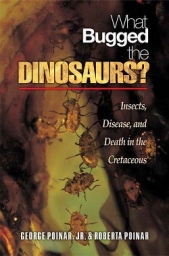
Мезозойскую эру обычно принято считать эпохой динозавров. Возможно, интересующиеся палеонтологией люди (не специалисты, разумеется) припомнят морских рептилий, ископаемых птиц или рыб. Но одни из самых распространённых и важных для существования экосистемы животных практически всегда оказываются вне поля зрения - это насекомые и другие беспозвоночные. Традиционно в книгах о доисторической жизни им уделяется прискорбно малое внимание: упоминаются, разве что, гигантские насекомые палеозоя, и, пожалуй, всё. Тем интереснее будет читать эту книгу людям, увлекающимся доисторической жизнью, поскольку эта книга ломает некоторые стереотипы. Она рассказывает об обитателях мелового периода мезозойской эры, но динозавры здесь - всего лишь статисты, фон для рассказа о других существах - о насекомых и других беспозвоночных, а также об их непростых отношениях с динозаврами. из этой книги читатель узнает о том, какие насекомые водились в лесах мелового периода, как они повреждали растения, служащие пищей динозаврам, как они сосали кровь динозавров и переносили болезни. Авторы книги - специалисты, много лет изучающие насекомых, сохранившихся в янтаре, и значительная часть книги написана на основе материала, полученного при изучении таких насекомых, обнаруженных в местонахождениях мелового возраста из Ливана, Бирмы и Канады.
В книге имеются чёрно-белые фотографии и рисунки. К сожалению, по причинам, не зависящим от переводчика книги, в ней отсутствуют упоминаемые в тексте многочисленные цветные вкладки. Может быть, когда-нибудь...
Внимание! Книга может содержать контент только для совершеннолетних. Для несовершеннолетних чтение данного контента СТРОГО ЗАПРЕЩЕНО! Если в книге присутствует наличие пропаганды ЛГБТ и другого, запрещенного контента - просьба написать на почту [email protected] для удаления материала
13. Poinar, Jr., G. O. & Milki, R. 2001. Lebanese Amber. Oregon State University Press, Corvallis, 96 pp.14. Davies, E. H. 2001. Palynological analysis of two Burmese amber samples. Unpublished report by Branta Biostratigraphy Ltd. for Leeward Capital Corp., 6 pp.15. Davies, E. H. 2001. Palynological analysis and age assignments of two Burmese amber sample sets. Unpublished report by Branta Biostratigraphy Ltd. for Leeward Capital Corp., 4 pp.16. Grimaldi, D. A., Engel, M. S. & Nascimbene, P. C. 2002. Fossiliferous Cretaceous amber from Myanmar (Burma). American Museum Novitates 3361, 71 pp.17. Poinar, Jr., G. O. 2004. Programinis burmitis gen. et sp. nov., and P. laminatus sp. nov., Early Cretaceous grass-like monocots in Burmese amber. Australian Systematic Botany 17: 497–504.18. Poinar, Jr., G. O. & Chambers, K. 2005. Palaeoanthella huangii gen. and sp. nov., an Early Cretaceous flower (Angiospermae) in Burmese amber. Sida 21: 2087–2092.19. Santiago-Blay, J. A., Anderson, S. R. & Buckley, R. T. 2005. Possible implications of two new angiosperm flowers from Burmese amber (Lower Cretaceous) for well-established and diversified insect-plant associations. Entomological News 116: 341–346.20. Zherikhin, V. V. & Ross, A. J. 2000. A review of the history, geology and age of Burmese amber (Burmite). Bulletin of the Natural History Museum, London (Geology) 56: 3–10.21. Braman, D. & Koppelhus, E. B. 2005. Campanian Palynomorphs. pp. 101–130 in Dinosaur Provincial Park, Currie, P. J. & Koppelhus, E. B. (eds.). Indiana University Press, Bloomington.22. Jarzen, D. M. 1982. Palynology of Dinosaur Provincial Park (Campanion) Alberta. Syllogeus 38: 1–69.23. Knowlton, F. H. 1905. Fossil plants of the Judith River beds. United States Geological Survey Bulletin 257:129–155.24. Bell, W. A. 1965. Upper Cretaceous and Paleocene plants of Western Canada. Geological Survey of Canada Paper 65-35:1–46.25. Colbert, E. H. 1983. Dinosaurs: An Illustrated History. Hammond Incorporated, Maplewood, NJ, 224 pp.26. Poinar, Jr., G. O. 2005. A Cretaceous palm bruchid, Mesopachymerus antiqua, n. gen., n. sp. (Coleoptera: Bruchidae: Pachymerini) and biogeographical implications. Proceedings of the Entomological Society of Washington 107: 392–397.
27. Ostrom, J. H. 1964. A reconsideration of the paleoecology of hadrosaurian dinosaurs. American Journal of Science 262: 975–997.28. Dodson, P. 1990. Counting dinosaurs: How many kinds were there? Proceedings of the National Academy of Sciences 87: 7608–7612.29. Dodson, P. 1997. Distribution and diversity. pp. 186–188 in Encyclopedia of Dinosaurs, Currie, P. J. & Padian, K. (eds.). Academic Press, New York.30. Fastovsky, D. E. & Weishampel, D. B. 2005. The Evolution and Extinction of the Dinosaurs, 2nd ed. Cambridge University Press, Cambridge, 485 pp.31. Norman, D. 2000. The evolution of Mesozoic flora and fauna. pp. 204–230 in The Scientific American Book of Dinosaurs, Paul, G. S. (ed.). St. Martin’s Griffin, New York.32. Holtz, Jr., T. R., Chapman, R. E. & Lamanna, M. C. 2004. Mesozoic biogeography of Dinosauria. pp. 627–642 in The Dinosauria, 2nd ed., Weishampel, D. B., Dodson, P. & Osmólska, H. (eds.). University of California Press, Berkeley.33. Daly, H. V., Doyen, J. T., & Purcell, A. H. 1998. Introduction to Insect Biology and Diversity, 2nd ed. Oxford University Press, Oxford, 680 pp.34. Kuschel, G. & Poinar, Jr., G. O. 1993. Libanorhinus succinus gen. and sp. n. (Coleoptera: Nemonychidae) from Lebanese amber. Entomologica Scandanavica 24: 143–146.35. Rasnitsyn, A. P. & Quicke, D. L. J. 2002. History of Insects. Kluver Academic Publishers, Dordrecht, 517 pp.36. Whalley, P. 1978. New taxa of fossil and recent Micropterigidae with a discussion of their evolution and a comment on the evolution of Lepidoptera (Insecta). Annals of the Transvaal Museum 31: 65–81.37. Zur Strassen, R. 1973. Fossile Fransenflugler aus mesozoischem Bernstein des Lebanon. Stuttgarter Beitrage für Naturkunde (Serie A) 267: 1–51.38. Heie, O. & Azar, D. 2000. Two new species of aphids found in Lebanese amber and a revision of the family Tajmyaphididae Kononova, 1975 (Hemiptera: Sternorrhyncha). Annals of the Entomological Society of America 93: 1222–1225.39. Poinar, Jr., G. O. & Brown, A. E. 2004. A new subfamily of Cretaceous antlike stone beetles (Coleoptera: Scydmaenidae: Hapsomelinae) with an extra leg segment. Proceedings of the Entomological Society of Washington 106: 789–796.40. Kirejtshuk, A. G. & Poinar, Jr., G. O. 2006. Haplochelidae, a new family of Cretaceous beetles (Coleoptera, Myxophaga) from Burmese amber. Proceedings of the Entomological Society of Washington 108: 155–164.41. Poinar, Jr., G. O. 2006. Mesophyletis calhouni (Mesophyletinae), a new genus, species and subfamily of Early Cretaceous weevils (Coleoptera: Curculionoidea: Eccoptarthridae) in Burmese amber. Proceedings of the Entomological Society of Washington 108: 878–884.42. Prasad, V., Strömberg, C. A. E., Alimohammadian, H. & Sahni, A. 2005. Dinosaur coprolites and the early evolution of grasses and grazers. Science 310: 1177–1180.43. Poinar, Jr., G. O. & Brown, A. 2005. New Aphidoidea (Hemiptera: Sternorrhyncha) in Burmese amber. Proceedings of the Entomological Society of Washington 107: 835–845.44. Poinar, Jr., G. & Danforth, B. N. 2006. A fossil bee from Early Cretaceous Burmese amber. Science 314: 614.45. Poinar, Jr., G. & Brown, A. E. 2002. A new genus of hard ticks in Cretaceous Burmese amber (Acari: Ixodida: Ixodidae). Systematic Parasitology 54: 199–205.46. Poinar, Jr., G. O. & Brown, A. E. 2004. A new genus of primitive crane flies (Diptera: Tanyderidae) in Cretaceous Burmese amber, with a summary of fossil tanyderids. Proceedings of the Entomological Society of Washington 106: 339–345.47. Poinar, Jr., G. O. & Brown, A. E. 2006. The enigmatic Dacochile microsoma Poinar & Brown: Tanyderidae or Bruchomyiinae? Zootaxa 1162: 19–31.48. Oberprieler, R. G. 2004. Antliarhininae Schoenherr, 1823 (Coleoptera, Curculionoidea). pp. 829–853 in Brentidae of the World (Coleoptera, Curculionoidea), Sforzi, A. & Bartolozzi, L. (eds.). Regione Piemonte, Torino.49. Heie, O. E. & Pike, E. M. 1992. New aphids in Cretaceous amber from Alberta (Insecta, Homoptera). Canadian Entomologist 124: 1027–1053.50. Poinar, Jr., G. O., Gorochov, A. V. & Buckley, R. 2007. Longioculus burmensis, n. gen., n. sp. (Orthoptera: Elcanidae) in Burmeseamber. Proceedings of the Entomological Society of Washington 109: 649–655.51. Borkent, A. 1995. Biting Midges in the Cretaceous Amber of North America (Diptera: Ceratopogonidae). Backhuys Publishers, Leiden, 237 pp.52. Bakker, R. T. 1986. The Dinosaur Heresies. Kensington Publication Corporation, New York, 481 pp.53. Strauss, S. Y. & Zangerl, A. R. 2002. Plant-insect interactions in terrestrial ecosystems. pp. 77–106 in Plant-Animal Interactions, Herrera, C. M. & Pellmyr, O. (eds.). Blackwell Science, Oxford.54. Peters, R. H. 1983. The Ecological Implications of Body Size. Cambridge University Press, Cambridge, 329 pp.55. Labandeira, C. C. 2002. The history of associations between plants and animals. pp. 26–74 in Plant-Animal Interactions, Herrera, C. M. & Pellmyr, O. (eds.). Blackwell Science, Oxford.56. Olesen, J. M. & Valido, A. 2003. Lizards as pollinators and seed dispersers: An island phenomenon. Trends in Ecology and Evolution 18: 177–181.57. Chamberlain, C. J. 1965. The Living Cycads. Hafner, New York, 172 pp.58. Cooper, M. R. & Goode, D. 2004. The Cycads and Cycad Moths of KwaZulu-Natal. Peroniceras Press, New Germany, KwaZulu-Natal, South Africa, 98 pp.59. Fullaway, D. T. & Krauss, N. L. H. 1945. Common Insects of Hawaii. Tongg Pub. Co., Honolulu, 228 pp.60. Hedrick, U. P. 1972. Sturtevant’s Edible Plants of the World. Dover Publications, New York, 686 pp.61. Marvaldi, A. E. 2005. Larval morphology and biology of orycornynine weevils (Belidae). Zoologica Scripta 34: 37–48.62. Naumann, I. D. 1991. Hymenoptera. pp. 916–1000 in The Insects of Australia, Naumann, I. D. (ed.), Vol. 2, 2nd ed.Comstock Publishing, Ithaca, NY.63. Miller, D. 1984. Common insects of New Zealand. A. H. & A. W. Reed, Wellington, New Zealand, 179 pp.64. Tillyard, R. J. 1926. The Insects of Australia and New Zealand. Angus & Robertson, Sydney, Australia, 560 pp.65. Furniss, R. L. & Carolin, V. M. 1977. Western Forest Insects. Miscellaneous publication No. 1339, United States Department of Agriculture, Forest Service, Washington, D.C. 654 pp.