Кто кусал динозавров?
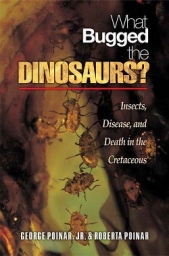
Кто кусал динозавров? читать книгу онлайн
Мезозойскую эру обычно принято считать эпохой динозавров. Возможно, интересующиеся палеонтологией люди (не специалисты, разумеется) припомнят морских рептилий, ископаемых птиц или рыб. Но одни из самых распространённых и важных для существования экосистемы животных практически всегда оказываются вне поля зрения - это насекомые и другие беспозвоночные. Традиционно в книгах о доисторической жизни им уделяется прискорбно малое внимание: упоминаются, разве что, гигантские насекомые палеозоя, и, пожалуй, всё. Тем интереснее будет читать эту книгу людям, увлекающимся доисторической жизнью, поскольку эта книга ломает некоторые стереотипы. Она рассказывает об обитателях мелового периода мезозойской эры, но динозавры здесь - всего лишь статисты, фон для рассказа о других существах - о насекомых и других беспозвоночных, а также об их непростых отношениях с динозаврами. из этой книги читатель узнает о том, какие насекомые водились в лесах мелового периода, как они повреждали растения, служащие пищей динозаврам, как они сосали кровь динозавров и переносили болезни. Авторы книги - специалисты, много лет изучающие насекомых, сохранившихся в янтаре, и значительная часть книги написана на основе материала, полученного при изучении таких насекомых, обнаруженных в местонахождениях мелового возраста из Ливана, Бирмы и Канады.
В книге имеются чёрно-белые фотографии и рисунки. К сожалению, по причинам, не зависящим от переводчика книги, в ней отсутствуют упоминаемые в тексте многочисленные цветные вкладки. Может быть, когда-нибудь...
Внимание! Книга может содержать контент только для совершеннолетних. Для несовершеннолетних чтение данного контента СТРОГО ЗАПРЕЩЕНО! Если в книге присутствует наличие пропаганды ЛГБТ и другого, запрещенного контента - просьба написать на почту [email protected] для удаления материала
151. Czerkas, S. 1994. The history and interpretation of sauropod skin impressions. pp. 173–182 in Aspects of Sauropod Paleobiology, Lockley, M. G., dos Santos, V. F., Meyer, C. A. & Hunt, A. P. (eds.). Gaia 10: 1–279.152. Currie, P. J. 2000. Feathered dinosaurs. pp. 183–189 in The Scientific American Book of Dinosaurs, Paul, G. S. (ed.). St. Martin’s Griffin, New York.153. Markle, W. H. & Makhoul, K. 2004. Cutaneous leishmaniasis: Recognition and treatment. American Family Physician 69:1455–1460.154. Smith, H. R. 1946. Handbook of Lizards. Comstock Publishing, Ithaca, NY, 557 pp.155. Reid, R. E. H. 1997. Dinosaurian physiology: The case for “intermediate dinosaurs.” pp. 449–473 in The Complete Dinosaur, Farlow, J. D. & Brett-Surman, M. K. (eds.). Indiana University Press, Bloomington.156. Borkent, A. 2000. Biting midges (Ceratopogonidae: Diptera) from Lower Cretaceous Lebanese amber with a discussion of the diversity and patterns found in other ambers. pp. 355–451 in Studies on Fossils in Amber, with Particular Reference to the Cretaceous of New Jersey, Grimaldi, D. (ed.). Backhuys Publishers, Leiden.157. Mullen, G. R. 2002. Biting midges (Ceratopogonidae). pp. 163–183 in Medical and Veterinary Entomology, Mullen, G. and Durden, L. (eds.). Academic Press, San Diego, CA.158. Meiswinkel, R. 1992. Afrotropical Culicoides: C. (Avaritia) laxodontis sp. nov., a new member of the imicola group (Diptera: Ceratopogonidae) associated with the African elephant in the Kruger National Park, South Africa. Onderstepoort Journal of Veterinary Research 59: 145–160.159. Seppa, N. 2004. Soldiers in Iraq coming down with parasitic disease. Science News 166: 53.160. Mullens, B. A., Barrows, C. & Borkent, A. 1997. Lizard feeding by Leptoconops (Brachyconops) californiensis (Diptera: Ceratopogonidae) on desert sand dunes. Journal of Medical Entomology 34: 735–737.161. Auezova, G. 1998. The biting midges (Diptera: Ceratopogonidae)— bloodsuckers of reptiles and bats—as possible collaborators of arboviruses circulating in nature. Parasitology International 47 (Suppl.): 306.162. Wirth, W. W. & Hubert, A. A. 1962. The species of Culicoides related to piliferus Root and Hoffman in eastern North America (Diptera, Ceratopogonidae). Annals of the Entomological Society of America 55: 182–195.163. Borkent, A. 1995. Biting midges (Ceratopogonidae: Diptera) feeding on a leatherback turtle in Costa Rica. Brenesia 43–44: 25–30.164. Szadziewski, R. & Poinar, Jr., G. O. 2005. Additional biting midges (Diptera: Ceratopogonidae) from Burmese amber. Polska Pismo Entomologiczne 74: 349–362.165. Purse, B. V., Mellor, P. S., Rogers, D. J., Samuel, A. R., Mertens, P. P. C. & Baylis, M. 2005. Climate change and the recent emergence of bluetongue in Europe. Nature Reviews Microbiology 3: 171–181.166. Wirth, W. W. & Lee, D. J. 1958. Australasian Ceratopogonidae (Diptera: Nematocera). Part VIII: Anew genus from Western Australia attacking man. Proceedings of the Linnean Society of New South Wales 83: 337–339.167. Poinar, Jr., G. & Telford, Jr., S. R. 2005. Paleohaemoproteus burmacis gen. n., sp. n., (Haemospororida: Plasmodiidae) from an Early Cretaceous biting midge (Diptera: Ceratopogonidae). Parasitology 131: 1–6.168. Atkinson, C. T. & Van Riper III, C. 1991. Pathogenicity and epizootiology of avian Haematozoa: Plasmodium, Leucocytoozoon, and Haemoproteus. pp. 19–48 in Loye, J. E. & Zuk, M. (eds.). Bird-Parasite Interactions: Ecology, Evolution, and Behaviour. Oxford University Press, New York.169. Fallis, A. M. & Bennett, G. F. 1961. Ceratopogonidae as intermediated hosts for Haemoproteus and other parasites. Mosquito News 21: 21–28.170. Paperna, I. & Landau, I. 1991. Haemoproteus (Haemosporidia) of lizards. Bulletin du Museum National Histoire, Paris 13: 309–349.171. Doherty, R. L., Carley, J. G., Standfast, H. A., Dyce, A. L., Kay, B. H. & Snowdon, W. A. 1973. Isolation of arboviruses from mosquitoes, biting midges, sandflies and vertebrates collected in Queensland, 1969 and 1970. Transactions of the Royal Society of Tropical Medicine and Hygiene 67: 536–543.172. Poinar, Jr., G. O. & Poinar, R. 2005. Fossil evidence of insect pathogens. Journal of Invertebrate Pathology 89: 243–250.173. Anderson, R. C. 2000. Nematode Parasites of Vertebrates, 2nd ed. CABI Publishing, Wallingford, England, 650 pp.174. Azar, D., Nel, A., Solignac, M., Paicheler, J.-C. & Bouchet, F. 1999. New genera and species of psychodoid flies from the Lower Cretaceous amber of Lebanon. Palaeontology 42: 1101–1136.175. Rutledge, L. C. & Gupta, R. K. 2002. Moth flies and sand flies (Psychodidae). pp. 147–161 in Medical and Veterinary Entomology, Mullen, G. & Durden, L. (eds.). Academic Press, San Diego, CA.176. Chaniotis, B. N. 1967. The biology of California Phlebotomus (Diptera: Psychodidae) under laboratory conditions. Journal of Medical Entomology 4: 221–233.177. Klein, T. A., Young, D. G., Telford, Jr., S. R. & Kimsey, R. 1987. Experimental transmission of Plasmodium mexicanum by bites of infected Lutzomyia vexator (Diptera: Psychodidae). Journal of the American Mosquito Control Association 3: 154–164.178. Da Silva, O. S. & Grunewald, J. 2000. First detection of blood in the gut of wild caught male sandflies in southern Brazil. Studies on Neotropical Fauna and Environment 35: 201–202.179. Perfilev, P. P. 1968. Phlebotomidae (sandflies). In Fauna of U.S.S.R. (Diptera), Vol. 33, No. 2, Akademiya Nauk SSSR, Moscow. (Translated from Russian by the Israel program for scientific translations, Jerusalem.) 363 pp.180. Boucot, A. J., Chen, Xu & Scotese, C. R. 2008. Preliminary compilation of Cambrian through Miocene climatically sensitive deposits. Memoirs of the Society of Economic Paleontologists and Mineralogists, Norman, OK (in press).181. Poinar, Jr., G. O., Jacobson, R. L. & Eisenberger, C. L. 2006. Early Cretaceous phlebotomine sand fly larvae (Diptera: Psychodidae). Proceedings of the Entomological Society of Washington 108: 785–792.182. Thomson, L. A. J. 2006. Agathis macrophylla (Pacific kauri). pp. 29–40 in Traditional Trees of Pacific Islands, Elevitch, C. R. (ed.). Holualoa, Hawaii.
183. Telford, Jr., S. R. 1995. The kinetoplastid hemoflagellates of reptiles. pp. 161–223 in Parasitic Protozoa, 2nd ed., Kreier, J. P. (ed.). Vol. 10. Academic Press, San Diego.184. Brygoo, E. R. 1963. Hematozoaires de Reptiles malgaches. 1. Trypanosoma therezieni n. sp. parasite des chameleons de Madagascar. Infestation naturelle et experimentale. Archives de Institute de Pasteur Madagascar 31: 133–141.185. Dedet, J.-P. 2002. Current status of epidemiology of leishmaniases. pp. 1–10 in Leishmania, Farrell, J. P.(ed.). Kluver Academic Publishers, Dordrecht.186. Montoya-Lerma, J., Cadena, H., Oviedo, M., Ready, P. D., Barazarte, R., Travi, B. L. & Lane, R. P. 2002. Comparative vectorial efficiency of Lutzomyia evansi and Lu. longipalpis for transmitting Leishmanial chagasi. Acta Tropica 85: 19–29.187. Yuval, B. 1991. Populations of Phlebotomus papatasi (Diptera: Psychodidae) and the risk of Leishmanial major transmission in three Jordan Valley habitats. Journal of Medical Entomology 28: 492–495.188. Schlein, Y. Warburg, A., Schnur, L. F. & Gunders, A. E. 1982. Leishmaniasis in the Jordan Valley II. Sandflies and transmission in the central endemic area. Transactions of the Royal Society of Tropical Medicine and Hygiene 76: 582–589.189. Ayala, S. C. 1970. Lizard malaria in California; description of a strain of Plasmodium mexicanum, and biogeography of lizard malaria in Western North America. The Journal of Parasitology 56: 417–425.190. Poinar, Jr., G. O. & Poinar, R. 1999. The Amber Forest, Princeton University Press, Princeton, NJ, 239 pp.191. Poinar, Jr., G. O., Zavortink, T. J., Pike, T. & Johnston, P. A. 2000. Paleoculicis minutus (Diptera: Culicidae) n. gen., n. sp., from Cretaceous Canadian amber, with a summary of described fossil mosquitoes. Acta Geologica Hispanica 35: 119–128.192. Day, J. F. & Curtis, G. A. 1983. Opportunistic blood-feeding on egg-laying sea turtles by salt marsh mosquitoes (Diptera: Culicidae). Florida Entomologist 66: 359–360.193. Fretey, J. 1989. Attaques diurnes ou nocturnes de Tortues luths par des Tabanidés et autres Diptères hématophages en Guyane francaise et au Surinam. L’Entomologiste 45: 237–244.