Как создавалась Библия
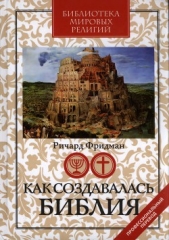
Как создавалась Библия читать книгу онлайн
Это одна из тех редких книг, которым одновременно присущи увлекательность и научная глубина, выдержанность классической библейской критики и смелость в рассмотрении запретных для многих тем. Кем и в каком мире была создана Библия? Были ли авторы современниками описываемых событий? Были ли среди них женщины? Как связаны реальная история и библейские рассказы? Зачем была написана Библия?
Одна из самых ярких попыток понять Ветхий Завет в наше время.
The Independent (Лондон)
Книга увлекательна и легко читается, — настоящее событие. И в ней угадывается постижение правды. Harvard Magazine
Фридман вводит читателя в проблему библейского авторства, и делает это умно и тонко.
New York Times Book Review
«Как создавалась Библия» — книга увлекательная и блестящая. Это не просто рассказ об открытиях прошлого. Она полна новых идей и свежих находок.
Я прочел ее на одном дыхании. Большую часть жизни я провел, читая книги о Библии, и должен признаться, что не помню другого случая, когда я не мог бы оставить книгу не прочтенной.
Франк Мур Кросс, профессор еврейского и других ближневосточных языков (Гарвардский университет)
Ричард Элиотт Фридман — профессор еврейского языка и сравнительной литературы в Калифорнийском университете (Сан-Диего).
Он защитил докторскую диссертацию в Гарвардском университете, работал в Оксфордском и Кембриджском университетах.
Внимание! Книга может содержать контент только для совершеннолетних. Для несовершеннолетних чтение данного контента СТРОГО ЗАПРЕЩЕНО! Если в книге присутствует наличие пропаганды ЛГБТ и другого, запрещенного контента - просьба написать на почту [email protected] для удаления материала
Насколько можно судить, этот список стоянок в Числ 33, как и Книга Поколений в Бытии, первоначально представлял собой отдельный документ. Затем редактор использовал его в качестве одного из способов соединить различные тексты в хронологически последовательное повествование.
Эта песнь, известная как Песнь Моисея, была вставлена в текст автором Dtr2. На это указывает тот факт, что некоторые темы и понятия, которые разрабатываются в Dtr2 (например, «сокрытие лица»), по-видимому, взяты из этой песни (стих 20).
Эта песнь, известная также как Благословение Моисея, по-видимому, первоначально представляла собой отдельное произведение, затем вставленное в текст.
Эти стихи повторяют текст Р в Числ 27:12–14. Перед нами редакторский эпаналепсис, снова поднимающий вопрос о смерти Моисея. Понадобился из-за добавления Второзакония к произведению.
Библиография
Addis, W.E. Documents of the Hexateucb. London, 1892.
Aharoni, Yohonan. “The Solomonic Temple, the Tabernacle, and the Arad Sanctuary.” In H. A. Hoffman, Jr., ed., Orient and Occident, Cyrus Gordon Festschrift. Neukirchen: Neukir-chener, 1973.
Albright, William Foxwell. The Biblical Period from Abraham to Ezra. New York: Harper, 1963.
— From the Stone Age to Christianity. Garden City, N.Y.: Doubleday, 1946, 1957.
Alt, Albrecht. Essays on Old Testament History and Religion. Garden City, N.Y.: Doubleday, 1966. German edition, Kleine Schriften zur Geschichte des Volkes Israel, I, II, III, 1953.
Astruc, Jean. Conjectures sur les memoires originaux dont il parait que Moyse s`est servi, pour composer le livre de la Genese 1753.
Bacon, Benjamin W. The Genesis of Genesis. Hartford, 1892.
Baltzer, Klaus. The Covenant Formulary. Philadelphia: Fortress, 1971. German edition, 1964.
Bright, John. A History of Israel, 3rd ed. Philadelphia: Westminster, 1981.
Brown, Raymond E.; Fitzmeyer, J. A.; and Murphy, R.E., eds. The Jerome Biblical Commentary. Englewood Cliffs, N.J.: Prentice-Hall, 1968.
Busink, Th.A. DerTempelvon Jerusalem. Leiden: Brill, 1970.
Carpenter, J. E., and Harford-Battersby, G. The Hexateuch. London: Longmans, Green, 1902.
Cheyne, Т. K. Founders of Old Testament Criticism. London: Methuen, 1893.
Clements, R. E. Abraham and David. London: SCM, 1967.
Cross, Frank Moore. Сanaanite Myth and Hebrew Epic. Cambridge: Harvard, 1973.
- “The Priestly Tabernacle.” Biblical Archeologist 10 (1947): 45-68.
Driver, S. R. Introduction to the Literature of the Old Testament. Gloucester: Peter Smith, 1972. Original edition, 1891.
Duff, Archibald. History of Old Testament Criticism. London: Watts, 1910.
Eissfeldt, Otto. The Old Testament, an Introduction. P. R. Ackroyd, trans. Oxford: Basil Blackwell, 1965.
Emerton, J. A. “The Origin of the Promises to the Patriarchs in the Older Sources of the Book of Genesis.” Vetus Testa-mentum 32:14–32.
Engnell, Ivan. A Rigid Scrutiny. Nashville: Vanderbilt University Press, 1969.
Fohrer, Georg. Introduction to the Old Testament. Nashville: Abingdon, 1968.
Frankfort, Henri; Frankfort, H.A.; Wilson, John; Jacobsen, Thorkild; and Irwin, W. A. The Intellectual Adventure of Ancient Man. Chicago: University of Chicago Press, 1946.
Freedman, David Noel. “Divine Commitment and Human Obligation.” Interpretation 18 (1964): 419–431.
_ “Pentateuch.” Interpreters Dictionary of the Bible.
_ Pottery, Poetry, and Prophecy. Winona Lake, Ind.: Eisenbrauns, 1980.
Friedman, Richard Elliott, ed. The Creation of Sacred Literature. Berkeley: University of California Press, 1981.
_ The Exile and Biblical Narrative. Harvard Semitic Monographs. Decatur, Ga.: Scholars Press, 1981.
_ ed. The Poet and the Historian. Harvard Semitic Studies. Decatur, Ga.: Scholars Press, 1984.
_ “The Tabernacle in the Temple.” Biblical Archeologist 43 (1980).
_, and Williamson, H. G. М., eds. The Future of Biblical Studies: The Hebrew Scriptures. Semeia Studies: Decatur, Ga.: Scholars Press, 1986.
Grant, Robert M. A Short History of the Interpretation of the Bible. New York: Macmillan, 1948.
Gray, Edward M. Old Testament Criticism. New York: Harper, 1923.
Habel, Norman. Literary Criticism of the Old Testament. Philadelphia: Fortress, 1971.
Hahn, E. The Old Testament in Modem Research. Philadelphia: Fortress, 1966.
Halpern, Baruch. The Constitution of the Monarchy in Israel. Harvard Semitic Monographs. Decatur, Ga.: Scholars Press, 1981.
_ The Emergence of Israel in Canaan. Society of Biblical Literature Monographs. Decatur, Ga.: Scholars Press, 1983.
_ “Sectionalism and the Schism.” Journal of Biblical Literature 93 (1974): 519–532.
Hanson, Paul. “Song of Heshbon and David’s NIR.” Harvard Theological Review 61 (1968): 297–320.
Haran, Menahem. “The Priestly Image of the Tabernacle.” Hebrew Union College Annual 36 (1965): 191–226.
_ “Shiloh and Jerusalem: The Origin of the Priestly Tradition in the Pentateuch.” Journal of Biblical Literature 81 (1962): 14–24.
_ Temples and Temple Service in Ancient Israel. New York: Oxford, 1978.
Herrmann, S. A History of Israel in Old Testament Times. Philadelphia: Fortress, 1975.
Hillers, Delbert. Covenant: The History of a Biblical Idea. Baltimore: Johns Hopkins, 1969.
Hobbes, Thomas. Leviathan, Part 3, Chapter 33. 1651.
Hurvitz, Avi. “The Evidence of Language in Dating the Priestly Code.” Revue Biblique 81 (1974): 24–56.
— A Linguistic Study of the Relationship Between the Priestly Source and the Book of Ezekiel. Cahiers de la Revue Biblique. Paris: Gabalda, 1982.
Hyatt, J. P. “Torah in the Book of Jeremiah ” Journal of Biblical Literature 60 (1941): 381–396.
Ishida, Tomoo, ed. Studies in the Period of David and Solomon and Other Essays. Tokyo: Yamakawa-Shuppansha, 1982.
Jenks, Alan W. The Elohist and North Israelite Traditions. Decatur, Ga.: Scholars Press, 1977.
Kapelrud, A. S. “The Date of the Priestly Code.” Annual of the Swedish Theological Institute III (1964): 58–64.
Kaufmann, Yehezkel. The Religion of Israel. Trans, and ed. Moshe Greenberg. Chicago: University of Chicago Press, 1960. Hebrew edition, 1937.
Kennedy, A. R.S. “Tabernacle.” Hastings Dictionary of the Bible IV: 653–668.
Knight, Douglas A. Rediscovering the Traditions of Israel. Society of Biblical Literature Dissertation Series. Decatur, Ga.: Scholars Press, 1973.
Levenson, Jon. “Who Inserted the Book of the Torah?” Harvard Theological Review 68 (1975): 203–233.
_, and Halpern, Baruch, eds. Traditions in Transformation: Turning-Points in Biblical Faith. Essays presented to Frank Moore Cross. Winona Lake, Ind.: Eisenbrauns, 1981.
Liver, Jacob. “Korah, Dathan, and Abiram.” Scripta Hieroso-lymitana 8. Jerusalem: Hebrew University, 1961.
Lohfink, Norbert. “Auslegung deuteronomischer Texte, IV”. Bibel und Leben 5(1964).
Lundbom, Jack R. “The Lawbook of the Josianic Reform.” Catholic Biblical Quarterly 38 (1976): 293–302.
Malamat, Abraham. “The Twilight of Judah: In the Egyptian-Babylonian Maelstrom.” Vetus Testamentum Supplements 28 (1975): 123–145.
_ “Origins and the Formative Period.” In H. H. Ben-Sasson, A History of the Jewish People, pp. 3-87. Cambridge, Mass.: Harvard University Press, 1976.