Проект Атман
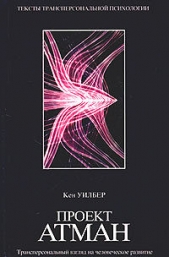
Проект Атман читать книгу онлайн
В книге одного из ведущих теоретиков трансперсональной психологии сопоставляются взгляды наиболее известных психологических школ и духовных традиций на эволюцию человека. Делается попытка аналитически разрешить проблему достижения всеединства — или проекта Атмана — как называет ее автор.
Издатели благодарят Алексея Купцова, чья финансовая помощь и дружеская поддержка сделали возможной публикацию этой книги. Перевод с английского под редакцией Александра Киселева Научный редактор кандидат философских наук Владимир Майков Серийное оформление Павла Иващука
Внимание! Книга может содержать контент только для совершеннолетних. Для несовершеннолетних чтение данного контента СТРОГО ЗАПРЕЩЕНО! Если в книге присутствует наличие пропаганды ЛГБТ и другого, запрещенного контента - просьба написать на почту [email protected] для удаления материала
[176]. Hall, R. The psycho‑philosophy of history. Main Currents, vol. 29, no. 2, 1972.
[177]. Harrington, A. The immortalist. New York: Random House, 1969.
[178]. Harris, T. I’’m o.k. — you" re o.k. New York: Avon, 1969.
[179]. Hartmann, H. Ego psychology and the problem of adaptation. New York: International Universities Press, 1958.
[180]. Hartshorne, C. The logic of perfection. Ulinoes: Open Cout, 1973.
[181]. Heard, G. The ascent of humanity. London: Jonathan Cape, 1929.
[182]. Heidegger, M. Existence andbeing. Chicago: Henry Regney, 1950.
[183]. Heidegger, M. Being and time. New York: Harper, 1962.
[184]. Heidegger, M. Discourse on thinking. New York: Harper.
[185]. Hixon, L. Coming home. Garden City: Anchor, 1978.
[186]. Hocart, A. Social origins. London: Watts, 1954.
[187]. Holdstock, Т., and Rogers, C. Person‑centered theory. In Corsini, R., reference note #88.
[188]. Hood, R. Conceptual Criticisms of regressive explanations of mysticisms. Rev. Religious Res., vol. 17, 1976.
[189]. Hook, S. (ed.) Dimensions of mind. New York: Collier, 1973.
[190]. Horney, K. The neurotic personality of our time. New York: Norton, 1968.
[191]. Hume, R., trans. The thirteen principle Upanishads. London: Oxford, 1974.
[192]. Husserl, E. Ideas. New York: Macmillan, 1931.
[193]. Huxley, A. The perennial philosophy. New York: Harper, 1970.
[194]. Jacobi, J. The psychology of С G. Jung. London: Routledge and Kegan Paul, 1968.
[195]. Jacobson, E. The self and the object world. New York: International Universities Press, 1964.
[196]. Jakobson, R. Child language aphasia and phonological universals. Quoted in Gardner, reference note #149.
[197]. James, W. The principles of psychology, vols. 1–2. New York: Dover, 1950.
[198]. James, W. Varieties of religious experience. New York: Collier, 1961.
[199]. Jantsch, E., and Waddington, C. (eds). Evolution and consciousness. Addison‑Wesley, 1976.
[200]. Jaynes, J. The origin of consciousness in thebreakdown of thebicameral mind. Boston: Houghton Mifflin, 1976.
[201]. John of the Cross, St. Dark night of the soul. Garden City: Doubleday, 1959.
[202]. John of the Cross, St. Ascent of Mount Carmel. Garden City: Doubleday, 1958.
[203]. Jonas, H. The gnostic religion. Boston: Beacon, 1963.
[204]. Jones, R. M. Contemporaty educational psycholgy: selected essays. New York: Harper, 1967.
Jung, C. G. The collected work of C. G. Jung, Adler, G., Fordham, M. and Read, H., eds.; Hull, R. F. C. trans. Bolligen Series XX, Princeton: Princeton Univ. Press.
[205]. Jung, C. G. Symbols of transformation, collected works 5.
[206]. Jung, C. G. Psychological types, collected works 6.
[207]. Jung, C. G. Two essays on analytical psychology, collected works 7.
[208]. Jung, C. G. The psychological foudations ofbelief in spirits, collected works 8.
[209]. Jung, C. G. The structure and dynamics of the psyche, collected works 8.
[210]. Jung, C. G. The archetypes and the collective unconscious, collected works 9.
[211]. Jung, C. G. Aion — researches into the phenomenology of the self, collected works 9, part 2.
[212]. Jung, C. G. Mysterium coniunctionis, collected works 14.
[213]. Jung, C. G. The portable Jung. Campbell, J., ed. New York: Viking, 1972.
[214]. Jung, C. G. Thebasic writings of С G. Jung. DeLaszlo, V. S., ed. New York: Modern Library, 1959.
[215]. Kadloubovsky, E., and Palmer, G., trans. Writings from the «Philokalia» on prayer of the heart. Lodon: Farber and Farber, 1954.
[216]. Kahn, H. I. The soul whence and whither. New York: Sufi Order, 1977.
[217]. Kaplan, B. (ed.) The inner world of mental illness. New York: Harper, 1964.
[218]. Kaplan, L. Oneness and separateness. New York: Simon and Schuster, 1978.
[219]. Kaplan, P. «An excursion into the “undiscovered country.”» Rediscovery of thebody. Garfield, C. (ed). New York: Dell, 1977.
[220]. Kapleau, P. The three pillars of Zen. Boston: Beacon, 1965.
[221]. Keleman, S. Yourbody speaks its mind. New York: Simon and Schuster, 1975.
[222]. Kierkegaard, S. The concept of the dread. Princeton: Princeton Univ., 1944.
[223]. Kierkegaard, S. Fear and trembling and the sickness unto death. New York: Anchor, 1954.
[224]. Klein, G. S. Psychoanalytic theory: an exploration of essentials. New York: International Universities Press, 1976.
[225]. Klein, M. The psychoanalysis of children. New York, 1960.
[226]. Klein, M. New directions in psychoanalysis. London: Tavistock, 1971.
[227]. Kluckhohn, C, and Murray, H. Personality: in nature, society, and culture. New York: Knopf, 1965.
[228]. Kobasa, S., and Maddi, S. Existential personality theory. In Corsini, R., reference note #88.
[229]. Kohlberg, L. Development of moral character and moral ideology. In Hoffman, M. and Hoffman, L. (eds). Review of Child Develorment Research, vol. 1, 1964.
[230]. Kohlberg, L. «From is to ought». In Mischel. T. (ed). Cognitive development and epistemology. New York: Academic Press, 1971.
[231]. Krishna, Gopi. The secret of yoga. New York: Harper, 1972.
[232]. Krishnamurti, J. The first and last freedom. Wheaton, Quest, 1968.
[233]. Krishnamurti, J. Commentaries on living. Series 1–3. Wheaton, Quest, 1968.
[234]. Kuhn, T. The structure of scientific revolutions. Chicago: Univ. of Chicago Press, 1962.
[235]. LaBarre, W. The human animal. Chicago: Univ of Chicago Press, 1954.
[236]. Lacan, J. Language of the self. Baltimore: John Hopkins, 1968.
[237]. Lacan, J. «The insistence of the letter in the unconscious». In Ehrmann, J., reference note #101.
[238]. Laing, R. D. The divided self. Baltimore: Penguin, 1965.
[239]. Laing, R. D. The politics of experience. New York» Ballantime, 1967.
[240]. Levi‑Strauss, С Structural anthropology. New York: BasicBooks, 1963.
[241]. Lifton, R. Revolutionary immortality. New York: Vintage, 1968.
[242]. Lilly, J. The center of the cyclone. New York: Julian, 1972.
[243]. Loevinger, J. Ego development. San Francisco: Jossey‑Bass, 1976.
[244]. Loewald, H. «The superego and the ego‑ideal. II: Superego and time». International Journal of Psychoanalysis, vol. 43, 1962.
[245]. Loewald, H. «On motivation and instinct theory» Psychoanalytic Study of the Child, vol.26, 1971.
[246]. Loewald, H. Psychoanalysis and the history of the individual. New Haven: Yale, 1978.
[247]. Lonergan, B. Insight, a study of human understanding. New York: Philosophical Library, 1970.
[248]. Longchenpa, Kindlybent to ease us. cols. 1–2. Guenther, H., trans. Emeryville: Dharma press, 1975.
[249]. Loween, A. Thebetrayal of thebody. New York: Macmillan, 1967.
[250]. Loween, A. The language of thebody. New York: Macmillan, 1967.
[251]. Loween, A. Depression and thebody. Baltimore: Penguin, 1973.
[252]. Luk, C. Ch’’an and Zen teaching, Series 1–3. London: Rider, 1960,1961, 1962.
[253]. Luk, C. The secrets of Chinese meditation. New York: Weiser, 1971.
[254]. Luk, C. PracticalBuddhism. London: Rider, 1972.
[255]. Luk, C. trans. The Surangama Sutra. London: Rider, 1969.
[256]. Luk, C. trans. The Vimalakirti Nirdessa Sutra. Berkeley: Shambhala, 1972.